How much does a concrete driveway cost in Cedar Park?
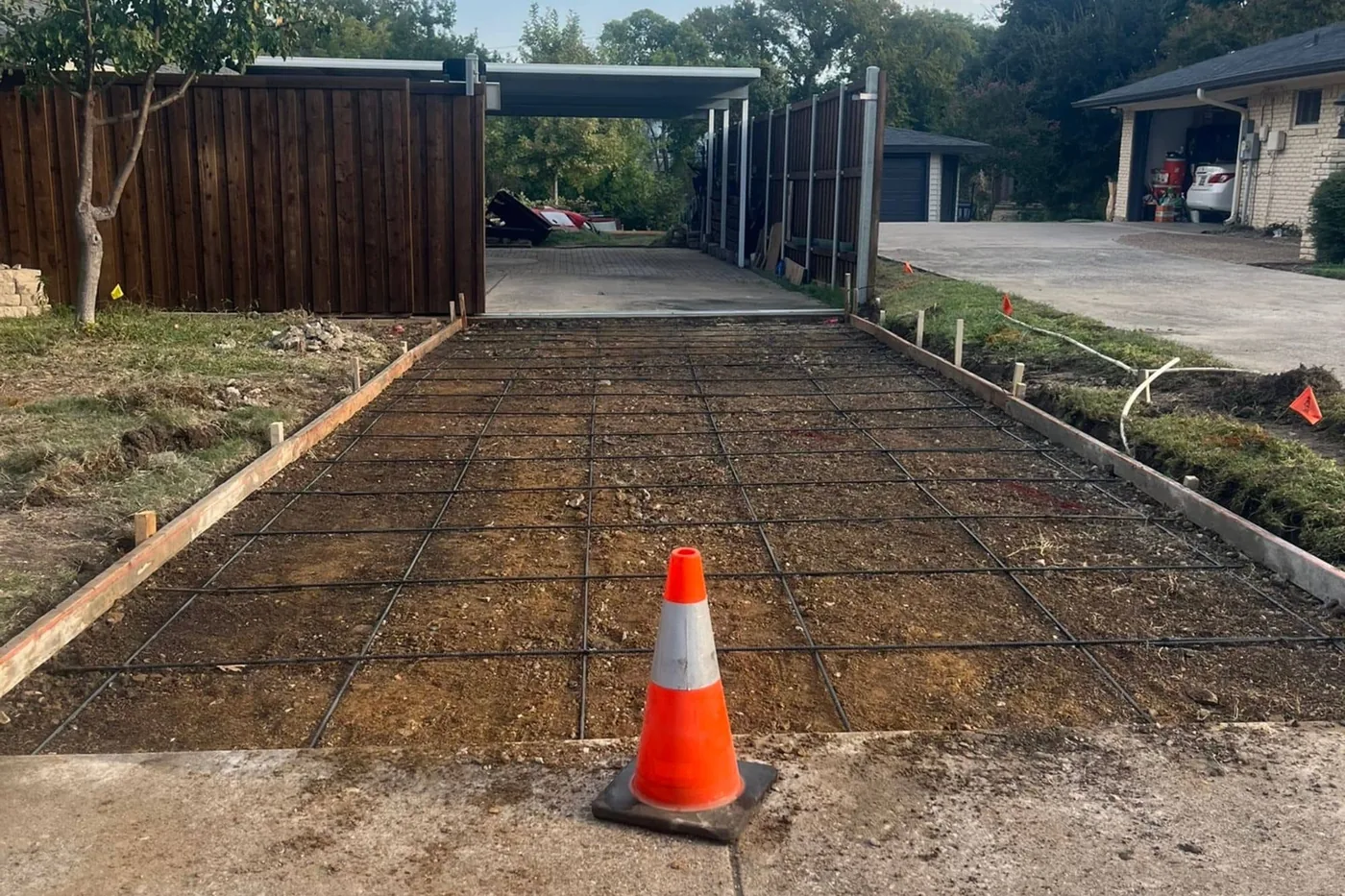
A driveway here costs more than a bare flatwork line because the base has to suit the actual ground. On the west side, which is most of town, that often means cutting and keying into shallow limestone or caliche, slower going than turning over soft dirt; a clay-heavier east-side lot gets a conditioned, compacted base instead. Both get a reinforcement grid and a planned joint layout. A standard residential driveway starts around $8 to $14 per square foot, climbing for decorative finishes or a serious tear-out, then tracking square footage, thickness, finish, and demolition from there. We commit to a number after we have stood on your lot, not sight unseen on a call.
How do you keep a driveway from cracking in Cedar Park?
It starts with fitting the base to the ground. On shallow rock we cut and key a level bearing surface so the slab does not teeter on an uneven ledge; on the deeper clay east of town we condition and compact so shrink-swell soil cannot heave the slab from below. Over either one, a reinforcement grid and a deliberate joint plan route the movement that does happen into the lines we choose.
Why do driveways crack on rocky lots?
Usually it is a base that ignored what was underneath. Shallow limestone is steady, but if a ledge is left uneven a slab bridges the high and low spots and cracks where it spans them. Out toward the clay the soil swells after rain and pulls in during drought, so a thin slab on an unprepared base spans ground that will not hold still. We settle the cause at the base, cutting the rock true or conditioning the soil, then guide the rest into joints.
How thick should a concrete driveway be?
For day-to-day passenger vehicles we land in the 4 to 6 inch range, going deeper under RVs or heavy trucks. We tune it to what you genuinely park and to how active the ground is, which means a bit more slab over the deeper clay than over solid rock, instead of pouring one stock thickness across every lot.
When can I drive on a new concrete driveway?
Walk it first, park on it later, because concrete keeps building strength well past the point it looks set, and a summer pour has to cure rather than bake. The exact dates for your pour go to you before we begin.
Can you tear out and replace my old driveway?
Yes. The demolition, the haul-off, and the new pour all sit under one quote. A slab that has split down the center or dropped at a corner on a settled lot usually traces back to a base that never reckoned with the rock or clay underneath, and the rebuild corrects that.